Regime-Based Asset Allocation: Adapting Portfolios to Changing Market Environments
Understanding Market Regimes
Financial markets don't behave uniformly across time. They operate in distinct regimes—persistent states characterized by unique relationships between asset classes, risk factors, and economic variables. Traditional static allocation approaches often underperform during regime transitions, while adaptive, regime-aware strategies may provide superior performance across full market cycles.
Defining Market Regimes: Beyond Bull and Bear
While the simplest regime classification divides markets into bull and bear phases, this binary approach fails to capture the rich complexity of market behavior. More sophisticated frameworks typically identify multiple regimes characterized by:
- Volatility Environments: Low, moderate, or high market volatility
- Correlation Structures: How different asset classes move together or diverge
- Trend Characteristics: Momentum or mean-reversion dominance
- Economic Backdrops: Growth, inflation, and monetary policy conditions
These regimes typically persist for months or years rather than days or weeks, making them suitable for strategic and tactical asset allocation decisions.
Economic, Volatility, and Correlation Regimes
Three primary frameworks for regime identification include:
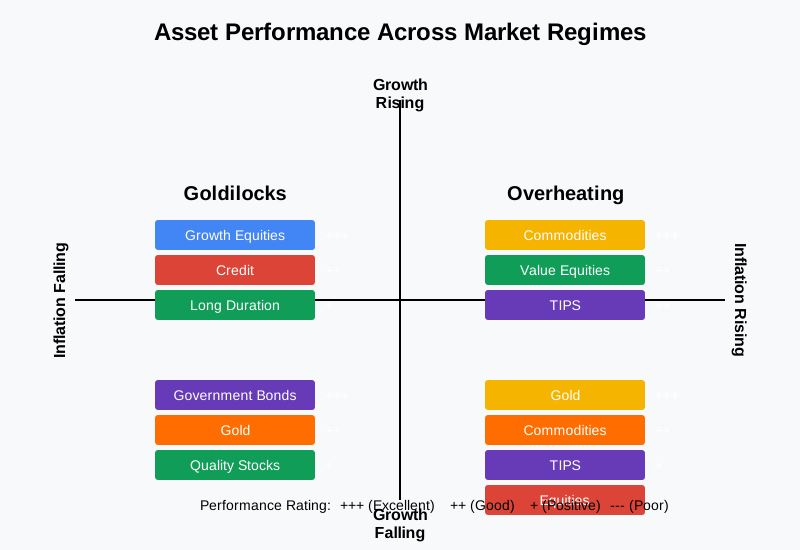
- Economic Regimes: Classified by growth and inflation dynamics
- Growth rising, inflation rising (overheating)
- Growth rising, inflation falling (goldilocks)
- Growth falling, inflation rising (stagflation)
- Growth falling, inflation falling (recession)
- Volatility Regimes: Categorized by market volatility levels
- Low volatility (risk-seeking behavior dominant)
- Rising volatility (increasing uncertainty)
- High volatility (crisis or stress periods)
- Falling volatility (recovery phases)
- Correlation Regimes: Defined by how asset classes move relative to each other
- Normal correlations (diversification benefits intact)
- Correlation breakdown (traditional relationships changing)
- Crisis correlations (convergence toward 1.0 across risk assets)
Sophisticated regime-based approaches often integrate aspects of all three frameworks to develop a comprehensive view of the current market environment.
The Impact of Regime Shifts on Asset Returns
The performance of various asset classes differs dramatically across market regimes:
- During growth-oriented regimes, equities typically outperform while bonds lag
- In inflationary environments, commodities and inflation-protected securities often excel
- High-volatility regimes typically favor defensive assets like high-quality bonds and gold
- During falling-volatility periods, credit assets and risk premia strategies tend to perform well
These performance differentials can be substantial—often exceeding 10% annualized return gaps between top and bottom-performing assets across different regimes. This creates significant potential value for allocation strategies that can successfully adapt to regime changes.
Identifying Market Regimes
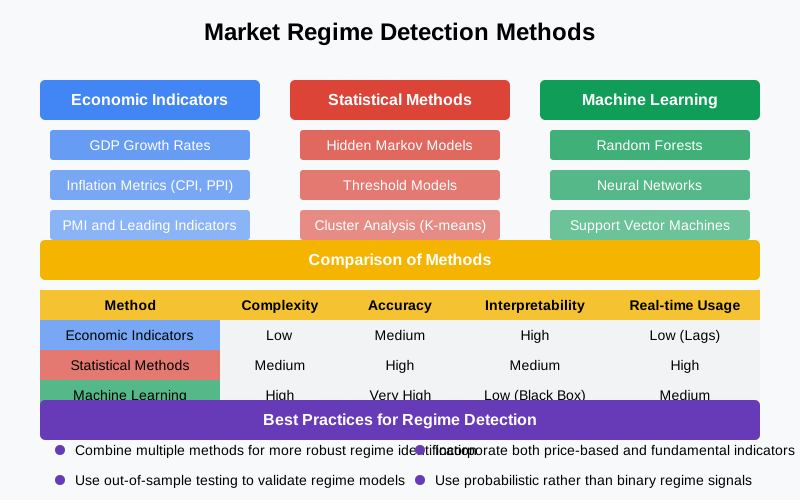
Accurate regime identification requires a blend of economic analysis, statistical methods, and often machine learning techniques to detect patterns in market behavior.
Macroeconomic Indicators and Regime Detection
Fundamental economic data provides the foundation for many regime identification models:
- Growth Indicators: GDP, industrial production, employment trends, and purchasing manager indices
- Inflation Metrics: Consumer price indices, producer prices, wage growth, and inflation expectations
- Monetary Policy: Interest rates, central bank balance sheets, and liquidity measures
- Credit Conditions: Lending standards, credit spreads, and default rates
These variables can be analyzed individually or combined into composite indicators that signal regime transitions, such as leading economic indicators or financial conditions indices.
Statistical Approaches to Regime Classification
Statistical methods offer more objective and systematic approaches to regime identification:
- Threshold Models: Classify regimes based on when key variables cross predetermined levels (e.g., VIX above 30 signaling high volatility)
- Clustering Algorithms: Group historical periods with similar characteristics using techniques like k-means clustering
- Hidden Markov Models: Identify unobservable regime states from observable market data, modeling both the regime states and transition probabilities
- Change-Point Detection: Identify structural breaks in time series that may signal regime shifts
These methods can be applied to various market variables including volatility, correlations, returns, and economic indicators to identify consistent regime patterns.
Machine Learning Applications for Regime Identification
Advanced machine learning techniques are increasingly used for more sophisticated regime detection:
- Classification Algorithms: Support vector machines, random forests, and neural networks trained to identify regime patterns
- Dimensionality Reduction: Principal component analysis and t-SNE to visualize market states in lower dimensions
- Reinforcement Learning: Dynamic approaches that learn optimal regime classification based on investment performance
- Natural Language Processing: Analyzing news sentiment and central bank communications for regime insight
These approaches can potentially capture more complex relationships and non-linear patterns that simpler methods might miss.
Markov Regime-Switching Models
Among various regime identification techniques, Markov regime-switching models have emerged as particularly valuable for financial applications due to their strong theoretical foundation and empirical performance.
Mathematical Framework and Applications
Markov regime-switching models assume that observed market data is generated by multiple distinct processes (regimes), with transitions between regimes governed by a hidden Markov process:
- Each regime has its own set of parameters (mean returns, volatilities, correlations)
- The regime state is not directly observable but must be inferred from market data
- Transitions between regimes follow a Markov process, where the probability of moving to a new regime depends only on the current regime
These models can be applied to various financial time series including returns, volatility, economic indicators, or combinations of these variables.
Estimating Transition Probabilities
A key component of Markov models is the transition probability matrix, which specifies the likelihood of moving from one regime to another:
- Higher diagonal probabilities indicate more persistent regimes
- Off-diagonal elements represent the probability of regime shifts
- Estimation typically uses maximum likelihood methods or Bayesian approaches
These transition probabilities provide valuable insight into regime persistence and the likelihood of imminent regime shifts, which can inform portfolio positioning.
Limitations and Considerations
While powerful, Markov regime-switching models have important limitations to consider:
- Parameter Stability: The estimated parameters can be sensitive to the sample period
- Regime Number Selection: Determining the optimal number of regimes involves trade-offs between fit and complexity
- Look-Ahead Bias: Current regime probabilities may be estimated with precision in-sample but are subject to uncertainty in real-time
- Computational Complexity: More sophisticated models with multiple regimes and variables can be computationally intensive
Practitioners often address these challenges through robust estimation methods, out-of-sample testing, and combining model outputs with other regime indicators.
Asset Behavior Across Different Regimes
Understanding how different asset classes perform across regimes is essential for developing effective allocation strategies.
Equities in Expansion vs. Contraction Regimes
Equity performance varies significantly across economic regimes:
- Expansion + Low Inflation: Typically the best environment for equities, particularly growth stocks
- Expansion + Rising Inflation: Positive but moderating equity returns, with value often outperforming growth
- Contraction + Disinflation: Challenging for equities broadly, though defensive sectors may outperform
- Contraction + Inflation (Stagflation): Usually the worst environment for equities, with few safe havens
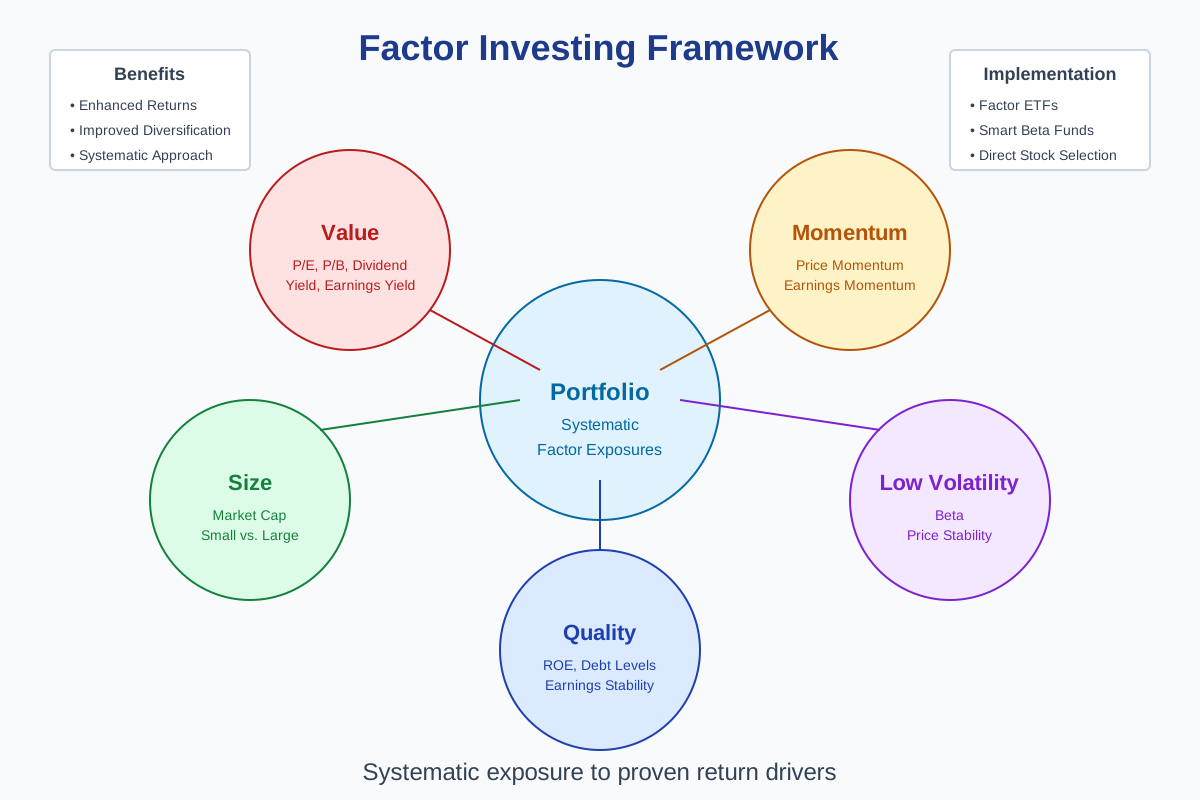
Within equities, factor performance also shows strong regime dependence, with factors like value, momentum, and quality performing differently across market environments.
Fixed Income Across Inflation Regimes
Fixed income assets exhibit particularly strong regime-dependent behavior:
- Low/Stable Inflation: Government bonds typically perform well, with longer duration offering better returns
- Rising Inflation: Challenging for nominal bonds, while inflation-protected securities and floating-rate instruments fare better
- High/Falling Inflation: Long-duration bonds often excel as yields decline from high levels
- Deflation: High-quality sovereign bonds typically outperform all other asset classes
Credit assets show additional regime sensitivity, with spread compression during growth phases and widening during contractions.
Alternative Assets and Their Regime-Dependent Performance
Alternative assets can provide valuable diversification across different regimes:
- Commodities: Generally excel during inflationary periods but lag during deflationary regimes
- Real Estate: Tends to perform well in moderate growth/inflation environments but struggles during high-rate regimes
- Gold: Often outperforms during periods of financial stress, currency debasement, or extreme uncertainty
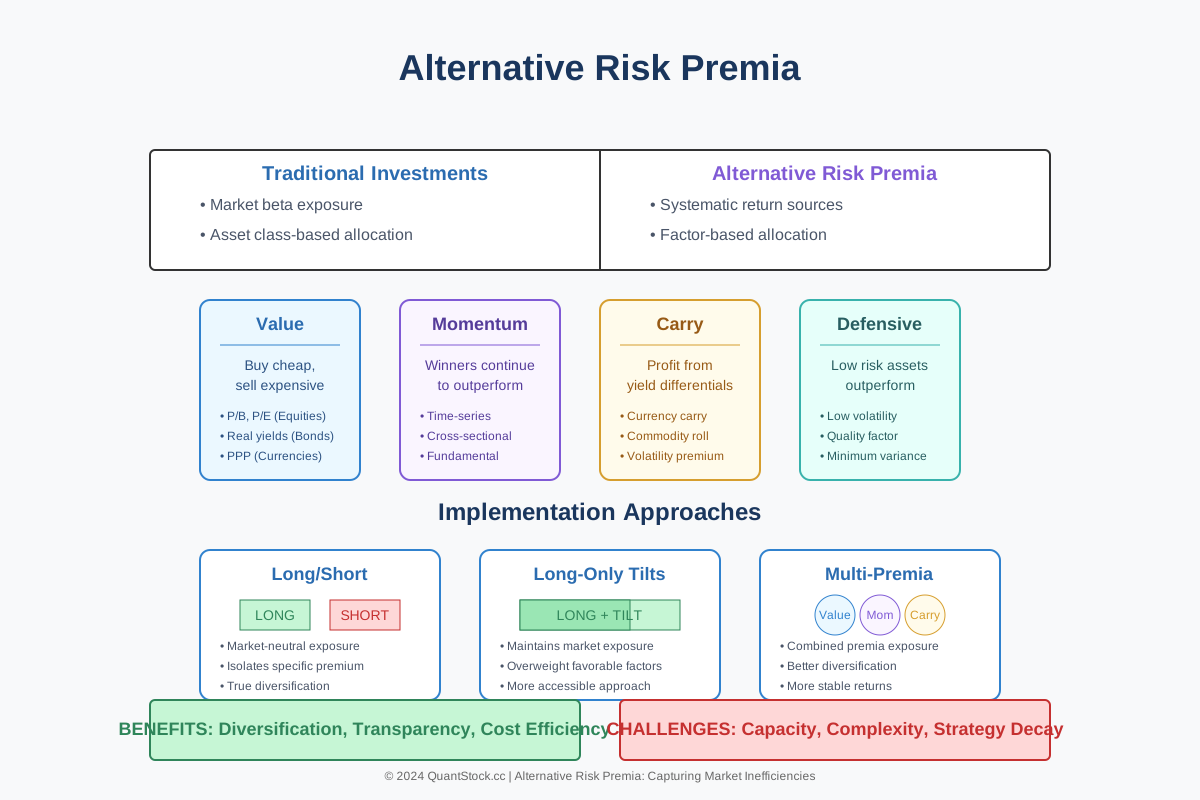
- Hedge Funds and Alternative Risk Premia: Performance varies by strategy, with some approaches specifically designed for certain regime environments
These non-traditional assets can significantly enhance portfolio resilience across different market regimes when properly incorporated.
Building Regime-Based Allocation Strategies
Translating regime identification into actionable portfolio allocations requires careful methodology development.
Tactical vs. Strategic Approaches
Regime-based allocation can be implemented across different time horizons:
- Strategic Regime-Based Allocation: Builds a portfolio robust across multiple potential regimes without attempting to predict specific transitions
- Tactical Regime-Based Allocation: Actively adjusts allocations based on current or expected regime states
- Dynamic Regime-Based Allocation: Continuously updates allocations as regime probabilities evolve
Each approach involves different trade-offs between responsiveness to changing conditions and potential turnover costs.
Risk Targeting Across Regimes
Volatility often varies dramatically across regimes, creating challenges for maintaining consistent risk exposure:
- Constant Notional Exposure: Maintains fixed percentage allocations regardless of regime, resulting in varying risk levels
- Constant Risk Contribution: Adjusts position sizes to maintain stable risk levels as volatility changes across regimes
- Regime-Dependent Risk Budgeting: Intentionally varies portfolio risk based on regime attributes, potentially taking more risk in favorable environments
These risk management approaches significantly impact how a portfolio performs through regime transitions, particularly during volatility spikes.
Factor Exposures and Regime Management
Regime-based allocation can be implemented through factor exposures rather than asset classes:
- Macro Factor Management: Adjusting exposure to growth, inflation, interest rate, and liquidity factors based on regime
- Style Factor Rotation: Shifting between equity factors like value, momentum, and quality based on regime characteristics
- Alternative Risk Premia Allocation: Adjusting exposure to risk premia based on their regime-dependent behavior
This factor-based approach can provide more precise implementation of regime views than broad asset class shifts.

Implementation Challenges
Implementing regime-based allocation strategies involves navigating several practical challenges.
The Timing Problem
Accurately timing regime shifts presents a significant challenge:
- Regimes are typically only identifiable with certainty in retrospect
- Early signals may generate false positives leading to unnecessary turnover
- Delayed identification may miss crucial transition periods where asset behavior changes most dramatically
- Market anticipation may cause prices to adjust before regimes are fully established
Successful implementation typically requires probabilistic approaches that gradually adjust allocations as regime evidence accumulates rather than binary switches.
Portfolio Turnover and Transaction Costs
Regime-based approaches can generate significant turnover, which must be managed carefully:
- Frequent trading costs can erode the theoretical benefits of regime-based allocation
- Tax implications for taxable accounts may reduce after-tax returns
- Bid-ask spreads and market impact can be significant, particularly in less liquid markets
Effective implementation requires balancing responsiveness to regime changes against the real-world frictions of portfolio adjustments.
Model Risk and Robustness Testing
Regime-based allocation introduces model risk that must be managed:
- Specification Risk: Misspecified models may identify incorrect regimes or miss important transitions
- Estimation Risk: Parameter uncertainty can lead to suboptimal allocations even with correctly specified models
- Robustness Concerns: Models that work well in-sample may fail out-of-sample if overfitted
- Regime Evolution: The nature of regimes themselves may change over time as markets evolve
Robust implementation requires extensive testing across different time periods, out-of-sample validation, and potentially combining multiple regime identification approaches.
Case Studies: Regime-Based Strategies in Action
Examining how regime-based strategies performed during significant market events provides valuable insight into their practical application.
Performance During the 2008 Financial Crisis
The global financial crisis of 2008 provided a severe test for regime-based approaches:
- Models based on volatility indicators generally identified the regime shift early as market volatility spiked
- Correlation-based models captured the breakdown of traditional diversification as correlations converged toward 1.0
- Economic models often lagged as official economic data reflected the severity of the downturn with significant delay
- Multi-factor models incorporating market liquidity metrics typically performed best
The most successful strategies reduced risk exposure early in the crisis and re-engaged as stress indicators moderated, significantly outperforming static allocations.
Navigating the COVID-19 Market Disruption
The COVID-19 market shock in early 2020 presented unique challenges:
- Unprecedented speed of market decline caught many regime models by surprise
- Volatility-based approaches generally performed well, quickly identifying the extreme stress regime
- Economic models struggled with the sudden stop in economic activity and subsequent rapid recovery
- The swift policy response created different asset behavior than in previous stress regimes
The most effective strategies incorporated high-frequency data and adaptive learning to quickly recognize the unique nature of the pandemic shock.
Inflation Regime Adaptation in 2022-2023
The inflation surge of 2022-2023 created a challenging environment:
- Many models struggled initially as inflation reached levels not seen in decades
- Correlations between stocks and bonds turned positive, undermining traditional diversification
- Models incorporating inflation regime identification generally outperformed, emphasizing real assets and inflation-protected securities
- Factor models identified the shift toward value and away from growth as interest rates rose
This period highlighted the importance of incorporating inflation dynamics explicitly in regime identification rather than focusing solely on growth and market volatility.
Practical Framework for Investors
Developing an effective regime-based allocation framework requires a structured approach accessible to different types of investors.
Monitoring Regime Indicators
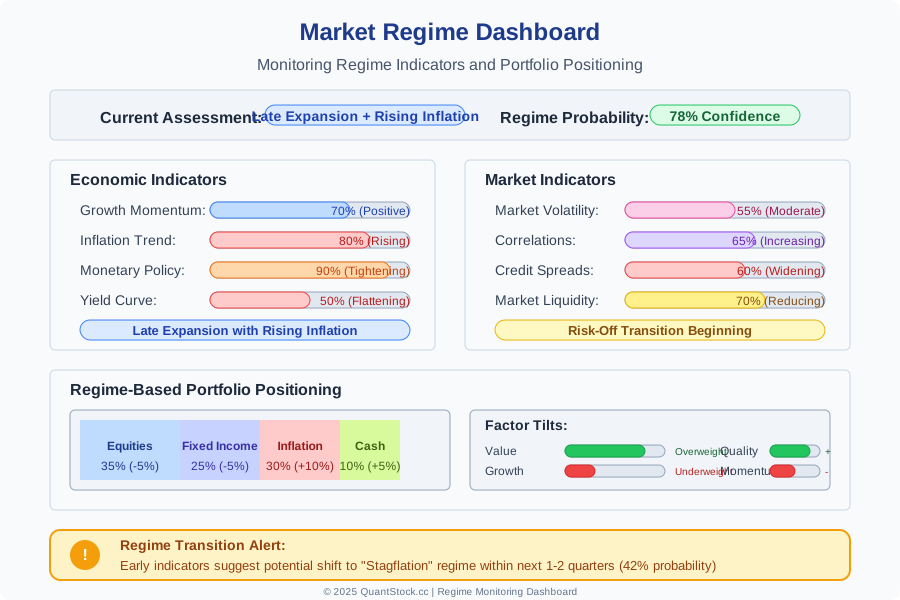
A practical monitoring framework might include:
- Economic Indicators: Growth momentum (PMIs, industrial production), inflation trends (CPI, PPI, wage growth), monetary policy (real rates, yield curves)
- Market-Based Signals: Volatility levels (VIX, realized volatility), correlation metrics, credit spreads, liquidity measures
- Sentiment and Positioning: Investor sentiment surveys, fund flows, futures positioning, risk appetite indicators
These can be combined into dashboard views with clear thresholds or probability indicators for different regime states.
Building Responsive But Robust Allocations
Effective regime-based allocation balances responsiveness and stability:
- Core-Satellite Structure: Maintaining a strategic core with tactical satellite allocations that respond to regime shifts
- Decision Rules: Predetermined allocation adjustments based on specific regime transitions, reducing discretionary decisions during stress periods
- Gradual Implementation: Phasing in allocation changes as regime probabilities evolve rather than binary switches
- Stress Testing: Evaluating how potential allocations would perform across historical regime episodes
This balanced approach helps capture the benefits of regime awareness while managing implementation challenges.
Integrating Regime Awareness with Existing Strategies
Investors can incorporate regime awareness without completely redesigning their approach:
- Risk Overlay: Maintaining existing allocations but adjusting overall risk exposure based on regime
- Tactical Tilts: Adding modest overweights and underweights to a strategic allocation based on regime indicators
- Factor Adjustment: Shifting factor exposures within asset classes rather than changing asset allocation
- Hedging Policies: Implementing regime-based hedging overlays during high-risk regimes
These approaches can provide meaningful benefits without requiring a complete portfolio redesign or excessive turnover.
Conclusion
Regime-based asset allocation represents a significant advancement beyond static portfolio construction approaches, acknowledging the dynamic and evolving nature of financial markets. By identifying distinct market states and adapting allocations accordingly, these strategies aim to enhance risk-adjusted returns across full market cycles while reducing the impact of significant drawdowns during regime transitions.
While not without implementation challenges, the regime-based framework offers valuable insights even for investors who maintain primarily strategic allocations. Understanding current and potential future regime states provides context for investment decisions and can help manage expectations during periods of market stress or transition.
The most successful implementations typically combine multiple regime identification approaches, incorporate both fundamental and market-based indicators, and implement allocation changes thoughtfully with attention to transaction costs and practical constraints. They also recognize that regime identification is inherently probabilistic rather than deterministic, leading to graduated rather than binary portfolio shifts.
As markets continue to evolve and new regimes emerge, adaptive allocation approaches that can identify and respond to changing conditions offer significant potential advantages over static methodologies that assume stable relationships between assets and risk factors.
To explore how regime-based concepts can be incorporated into your own investment approach, consider our portfolio optimization tools, which allow you to analyze how different allocations might perform across various market environments.
Free Trading Math & Risk Cheat Sheet
Every key formula in one PDF: breakeven win rates, expectancy, position sizing, drawdown recovery, volatility drag, VaR and CVaR. Plus occasional emails when we publish new quant tools.