Risk Parity: The Evolution of Balanced Portfolio Construction
The Origins and Evolution of Risk Parity
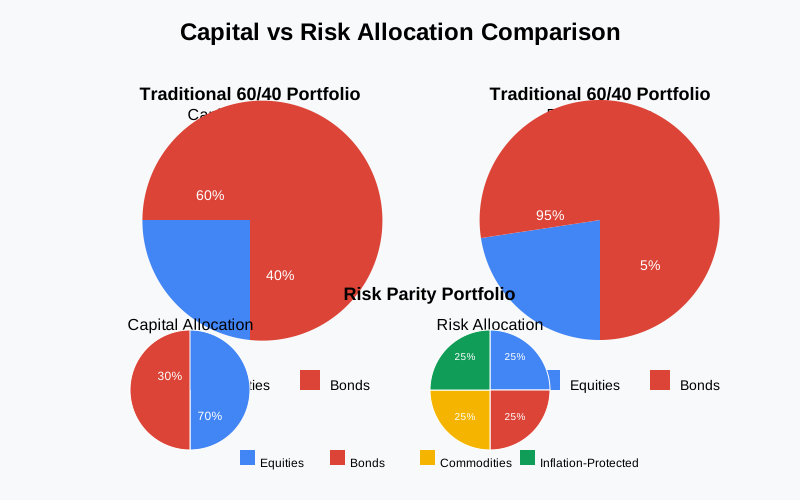
Traditional portfolio construction approaches have long been dominated by capital-weighted allocations, with the classic 60/40 stock/bond portfolio serving as the benchmark for balanced investing. However, this conventional wisdom has a fundamental flaw: it typically results in portfolios where 90% or more of the risk comes from stocks, creating a highly concentrated risk profile despite apparent diversification in dollar terms.
Bridgewater's All Weather Portfolio
The risk parity approach emerged in the 1990s, with Ray Dalio's Bridgewater Associates pioneering the concept through their "All Weather" strategy. This innovative approach sought to create a portfolio that could perform consistently across different economic environments by balancing risk exposures rather than capital allocations.
Dalio recognized that economic conditions can be categorized into four primary environments based on whether economic growth and inflation are rising or falling. Traditional portfolios are heavily exposed to growth environments but perform poorly when growth disappoints. The All Weather concept aimed to balance exposures across these different economic regimes.
Moving Beyond 60/40 Allocations
The 60/40 portfolio allocates 60% of capital to stocks and 40% to bonds, but this capital allocation translates to approximately:
- 90-95% of portfolio risk from stocks
- 5-10% of portfolio risk from bonds
This risk concentration means that despite apparent diversification, portfolio performance is overwhelmingly determined by equity market movements. Risk parity addresses this imbalance by redistributing risk rather than capital across asset classes.
The Mathematical Foundations
The theoretical foundation of risk parity draws on modern portfolio theory but shifts the focus from return optimization to risk balancing. Mathematically, risk parity seeks to equalize the risk contribution from each asset or asset class, where risk contribution is defined as:
Risk Contributioni = wi × σi × ρi,p × σp
Where:
- wi = Weight of asset i
- σi = Volatility of asset i
- ρi,p = Correlation between asset i and the portfolio
- σp = Portfolio volatility
In its simplest form, for uncorrelated assets, this would mean weighting each asset inversely proportional to its volatility.
Core Principles of Risk Parity
Risk parity represents a fundamentally different approach to portfolio construction, built on several core principles that distinguish it from traditional methods.
Risk Contribution vs. Capital Allocation
The central insight of risk parity is the focus on how much each asset contributes to overall portfolio risk rather than how much capital is allocated to each asset. This shift recognizes that:
- Equal capital allocation does not equal equal risk allocation due to differences in asset volatility
- A truly diversified portfolio should derive its risk from multiple sources rather than being dominated by a single asset class
- Risk contribution offers a more meaningful measure of an asset's influence on portfolio behavior than dollar allocation
By balancing risk contributions, risk parity aims to create portfolios where no single asset class dominates performance.
Volatility as a Risk Measure
Most risk parity implementations use volatility (standard deviation of returns) as their primary risk measure, though more sophisticated approaches may incorporate alternative risk metrics. Volatility is chosen because:
- It provides a standardized measure across different asset classes
- It can be reliably estimated from historical data
- It tends to be more stable than other risk metrics like correlations
Critics argue that volatility alone does not capture all aspects of risk, particularly tail risk or drawdown potential, leading to enhanced approaches that incorporate these considerations.
The Role of Correlation in Risk Balancing
Correlation between assets plays a crucial role in risk parity implementation. The risk contribution of an asset depends not only on its individual volatility but also on how it co-moves with other portfolio components.
- Lower correlations enhance the benefits of risk balancing
- Highly correlated assets are treated as sharing risk rather than diversifying it
- Changing correlation structures require periodic portfolio rebalancing to maintain risk parity
The most sophisticated risk parity implementations use full covariance matrices to capture these complex relationships rather than treating assets in isolation.
Implementation Approaches
Risk parity can be implemented through various methods, ranging from simple heuristics to sophisticated optimization algorithms.
Volatility-Based Risk Allocation
The simplest approach to risk parity weights assets inversely proportional to their volatility:
- Calculate the historical volatility (σi) for each asset
- Set initial weights proportional to 1/σi
- Normalize weights to sum to 100% (without leverage) or the target risk level (with leverage)
This approach works reasonably well when assets have low correlations but becomes less effective as correlations increase.
Factor-Based Risk Parity
More advanced implementations focus on balancing risk across underlying economic factors rather than asset classes:
- Growth Factor: Exposure to economic expansion (equities, credit, etc.)
- Inflation Factor: Sensitivity to inflation surprises (commodities, inflation-linked bonds, etc.)
- Real Rates Factor: Exposure to changes in real interest rates (nominal bonds, etc.)
- Liquidity Factor: Compensation for bearing liquidity risk
This approach recognizes that assets within the same class may respond differently to underlying economic drivers, providing more meaningful diversification.
Dynamic vs. Static Implementations
Risk parity portfolios can be implemented with varying degrees of responsiveness to changing market conditions:
- Static Risk Parity: Fixed risk allocations with periodic rebalancing to maintain target weights
- Dynamic Risk Parity: Adjusts risk allocations based on changing volatilities and correlations
- Tactical Risk Parity: Incorporates forecasts or regime indicators to adjust risk allocations
The trade-off involves balancing responsiveness to changing conditions against potential increased turnover and transaction costs.
Asset Class Considerations
Risk parity can incorporate a wide range of assets, with different considerations for each major asset class.
Traditional Assets in Risk Parity
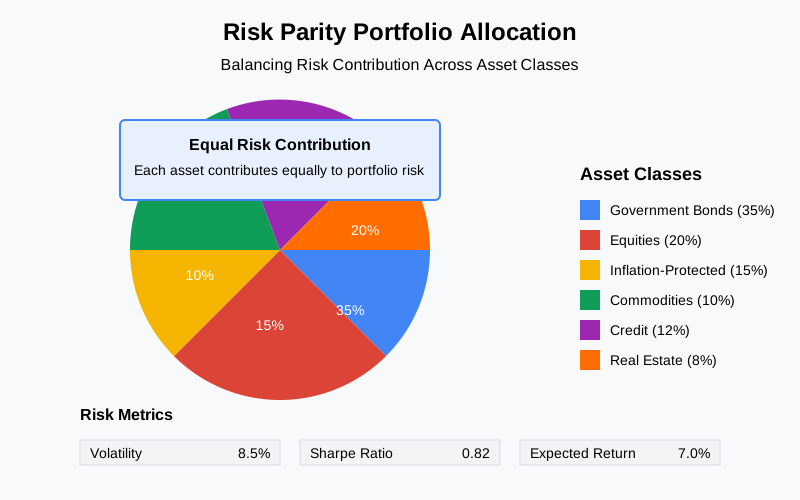
Core asset classes in most risk parity portfolios include:
- Equities: Providing growth exposure but typically allocated less capital than in traditional portfolios due to their high volatility
- Government Bonds: Offering stability and usually negative correlation with equities during stress periods, receiving more capital allocation than in traditional portfolios
- Inflation-Linked Bonds: Providing protection against unexpected inflation, a risk that both equities and nominal bonds are vulnerable to
- Credit: Offering a hybrid exposure between equity and interest rate risk
The exact implementation depends on the specific risk parity approach and the investor's objectives.
Alternative Investments
Many risk parity strategies incorporate alternative assets to provide additional diversification:
- Commodities: Particularly valuable for inflation protection and diversification from financial assets
- Real Estate: Providing both income and partial inflation protection
- Currencies: Offering distinct risk exposures uncorrelated with traditional assets
- Alternative Risk Premia: Systematic return sources across asset classes like value, momentum, and carry
These alternatives can significantly enhance the diversification benefits of risk parity but may introduce complexity and liquidity considerations.
Derivatives and Leverage
Derivatives play an important role in many risk parity implementations:
- Futures: Providing efficient exposure to major asset classes with minimal capital requirements
- Swaps: Enabling customized exposures to specific risk factors
- Options: Used in some implementations to manage tail risk or provide contingent exposures
These instruments enable the leverage often necessary to implement risk parity while maintaining liquidity and efficient execution.
The Leverage Debate
The use of leverage is perhaps the most debated aspect of risk parity implementation, with important considerations for investors.
Why Leverage Is Often Necessary
Leverage plays a central role in most risk parity implementations for several reasons:
- Lower-volatility assets like bonds need leverage to contribute meaningful returns while maintaining risk parity
- Without leverage, a risk parity portfolio would typically have lower expected returns than a traditional portfolio
- Leverage allows investors to target a specific risk level while maintaining balanced risk contributions
In essence, leverage in risk parity serves to increase the risk (and thus expected return) of lower-volatility assets rather than to amplify overall portfolio risk.
Managing Leverage Risk
Prudent leverage management is critical for successful risk parity implementation:
- Modest Leverage Levels: Most implementations use moderate leverage (typically 1.5-2.5x) rather than aggressive multiples
- Diversified Leverage: Spreading leverage across multiple asset classes rather than concentrating it
- Liquidity Management: Maintaining sufficient liquidity to meet potential margin calls or adjustments
- Counterparty Risk Monitoring: When using derivatives, carefully managing exposure to individual counterparties
These practices mitigate the specific risks associated with leverage while preserving its benefits for portfolio construction.
Limitations and Concerns
Despite careful management, leverage does introduce additional considerations:
- Funding Risk: The possibility of forced deleveraging during market stress if funding becomes unavailable
- Path Dependency: Leveraged portfolios can suffer from volatility drag, making the sequence of returns more important
- Implementation Complexity: Leverage requires more sophisticated infrastructure and risk management
- Psychological Barriers: Many investors have an aversion to leverage regardless of its actual risk implications
These factors have led to the development of "risk parity-lite" approaches that maintain the risk balancing principle while using less or no leverage.
Risk Parity Performance Analysis
Understanding the historical performance characteristics of risk parity provides context for its potential role in investment portfolios.
Historical Performance Through Market Cycles
Risk parity approaches have generally delivered on their objective of providing more consistent performance across different market environments:
- Competitive long-term returns compared to traditional balanced portfolios
- Less severe drawdowns during equity market declines
- Better performance during inflationary periods than traditional portfolios
- Lower volatility than equity-dominated portfolios
This performance profile reflects the more diversified risk allocation that is the core objective of the approach.
Performance During Market Crises
Risk parity's performance during major market disruptions provides insight into its resilience:
- 2008 Financial Crisis: Most risk parity strategies outperformed traditional portfolios due to their significant bond allocations
- 2013 Taper Tantrum: Risk parity generally underperformed as both stocks and bonds declined simultaneously
- 2020 COVID Crisis: Initial underperformance during the liquidity crisis followed by strong recovery as markets normalized
These episodes illustrate both the strengths and potential vulnerabilities of the approach during different types of market stress.
Comparison to Traditional Allocation Strategies
When compared to traditional strategic allocation approaches, risk parity typically offers:
- Lower maximum drawdowns over full market cycles
- Higher Sharpe ratios (risk-adjusted returns)
- More consistent performance across different economic regimes
- Less sensitivity to the starting point in market cycles
These advantages come at the cost of potentially lower raw returns during strong equity bull markets and more complex implementation requirements.
Common Criticisms and Challenges
Risk parity faces several legitimate criticisms that investors should consider when evaluating the approach.
Rising Interest Rate Environments
One of the most common criticisms of risk parity involves its vulnerability to rising interest rate environments:
- Higher bond allocations than traditional portfolios create greater sensitivity to interest rate increases
- Historical tailwind from falling rates since the 1980s may not continue going forward
- Periods of equity-bond correlation breakdown can disproportionately impact risk parity portfolios
Some risk parity implementations address this concern by incorporating inflation-hedging assets or dynamic duration management.
Correlation Breakdowns
Risk parity benefits from diversification, which depends on correlation relationships between assets:
- During market crises, correlations often increase (correlation convergence), reducing diversification when it's most needed
- The negative stock-bond correlation that has prevailed since 2000 is not a historical constant and could revert to positive
- Correlation instability can lead to rapid changes in portfolio risk characteristics
More sophisticated implementations attempt to address this through regime-based correlation modeling or dynamic allocation adjustments.
Crowding and Capacity Concerns
As risk parity has gained popularity, concerns have emerged about market impact:
- Concentration of assets in similar strategies could amplify market movements
- Simultaneous deleveraging during stress periods could exacerbate market dislocations
- Capacity constraints in certain markets (particularly some commodity futures)
While these concerns merit consideration, the total assets in dedicated risk parity strategies remain a small fraction of global markets, limiting their systemic impact.
Building Your Own Risk Parity Portfolio
Investors interested in implementing risk parity have several options depending on their resources and sophistication.
Simple vs. Sophisticated Approaches
Risk parity can be implemented with varying levels of complexity:
- Simple Implementation: Inverse volatility weighting across major asset classes, implemented through index ETFs
- Intermediate Approach: Incorporating correlations through portfolio optimization, using a broader set of sub-asset classes
- Advanced Implementation: Factor-based risk parity with dynamic adjustments and sophisticated risk modeling
The appropriate level depends on the investor's resources, expertise, and portfolio size.
Rebalancing Considerations
Maintaining risk parity requires periodic rebalancing as market conditions change:
- Volatility Shifts: Adjusting weights as the relative volatility of assets changes
- Correlation Changes: Rebalancing to account for evolving relationships between assets
- Fundamental Regime Changes: Potentially adjusting the approach during significant shifts in economic conditions
Balancing responsiveness against transaction costs and tax implications is an important consideration in rebalancing policy.
Monitoring and Performance Evaluation
Effective risk parity implementation requires ongoing monitoring and evaluation:
- Tracking actual risk contributions relative to targets
- Measuring performance across different market environments
- Evaluating risk-adjusted returns rather than absolute performance alone
- Comparing outcomes to both risk parity benchmarks and traditional allocation approaches
This evaluation should focus on whether the strategy is delivering its intended benefits of balanced risk exposure and improved diversification rather than just raw returns.
Conclusion
Risk parity represents a fundamental rethinking of portfolio construction, shifting focus from capital allocation to risk allocation. By balancing risk contributions across different assets and economic exposures, it aims to create more resilient portfolios that can perform across a range of market environments.
While not without challenges and criticisms, risk parity offers a thoughtful alternative to traditional approaches that are dominated by equity risk. Its emphasis on true diversification aligns with the fundamental goal of building portfolios that can weather various economic conditions rather than depending on a single growth narrative.
Whether implemented in its pure form or adapted as one component of a broader investment approach, the risk parity philosophy provides valuable insights for all investors seeking to build more balanced portfolios. Its core principle—that diversification should be measured in risk contribution rather than dollars—represents an enduring contribution to investment management thinking.
To explore how risk-based approaches can improve your portfolio construction, check out our portfolio optimization tools which incorporate sophisticated risk modeling techniques to help you build more resilient investment strategies.
Free Trading Math & Risk Cheat Sheet
Every key formula in one PDF: breakeven win rates, expectancy, position sizing, drawdown recovery, volatility drag, VaR and CVaR. Plus occasional emails when we publish new quant tools.