Retirement Planning Calculator: How Much Do You Need to Save for Retirement?
Building Your Retirement Savings Strategy
Retirement planning is one of the most important financial decisions you'll make. Our retirement planning calculator helps you determine exactly how much you need to save to maintain your desired lifestyle in retirement, accounting for inflation, investment returns, and your time horizon.
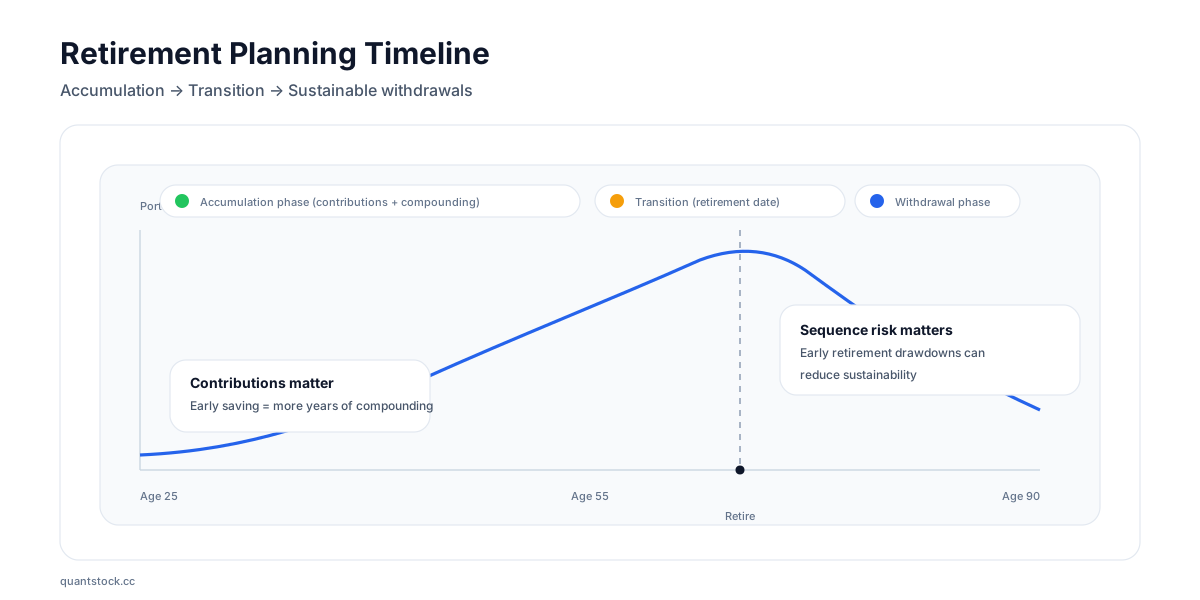
What This Calculator Does
The retirement planning calculator creates a comprehensive retirement savings roadmap based on your specific situation. It calculates three critical numbers:
Required Retirement Savings: The total nest egg you'll need on your retirement date to fund your desired lifestyle throughout retirement.
Current Savings Trajectory: Where your current savings and contribution rate will lead you, so you can see if you're on track or need adjustments.
Monthly Savings Needed: The exact monthly contribution required to reach your retirement goal, helping you close any savings gaps.
The calculator accounts for multiple factors including current age, retirement age, life expectancy, desired retirement income, current savings, expected investment returns, and inflation. This comprehensive approach provides realistic projections rather than oversimplified estimates.
Who Should Use This Calculator
This calculator is essential for:
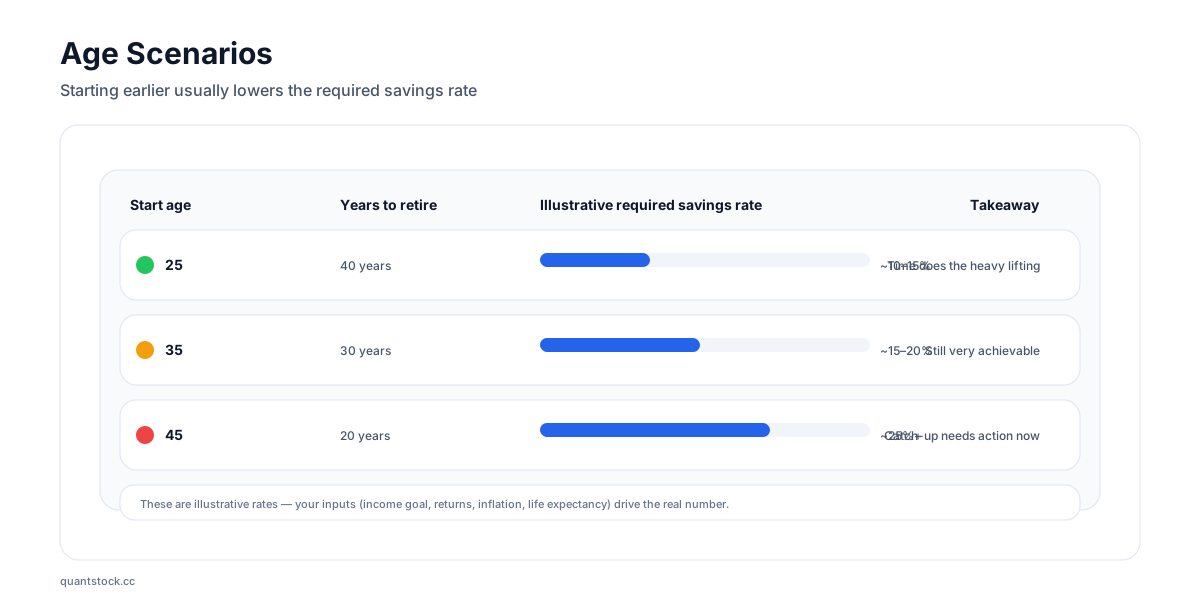
Mid-career professionals in their 30s and 40s who want to ensure they're saving enough for retirement. These are crucial decades for retirement savings, and the calculator helps you stay on track.
Recent graduates starting their first jobs with access to 401(k) plans. Early planning creates dramatic advantages through decades of compound growth.
Anyone approaching retirement within 5-10 years who needs to verify they've saved enough or determine if they need to adjust their retirement timeline or lifestyle expectations.
Career changers who may have gaps in retirement savings and need to calculate catch-up contribution requirements.
How the Calculator Works
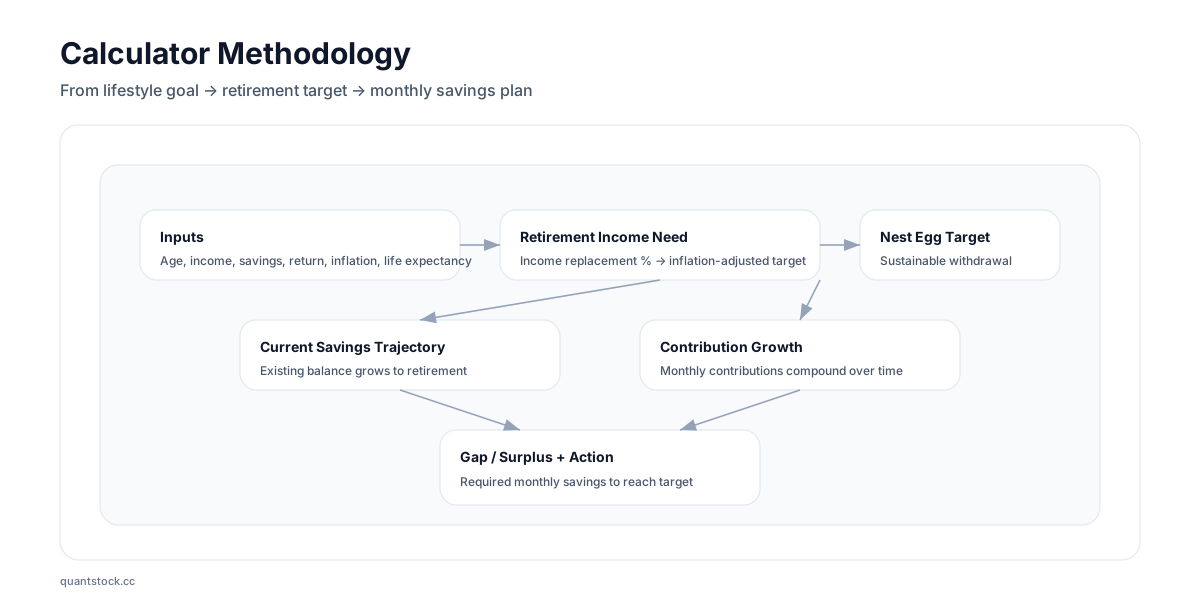
The retirement planning calculator uses several interconnected calculations:
Step 1: Determine Required Annual Retirement Income
The calculator starts with your desired retirement income, typically expressed as a percentage of your current income. Most financial planners recommend 70-90% income replacement. The calculator adjusts this amount for inflation over the years until you retire.
Step 2: Calculate Total Retirement Funding Needed
Using your inflation-adjusted retirement income need and life expectancy, the calculator determines the total nest egg required. It assumes you'll withdraw a sustainable percentage annually (typically 4% initially, adjusted for inflation), ensuring your money lasts throughout retirement.
Step 3: Project Your Current Savings Growth
Your current retirement savings grow at your expected investment return rate until retirement. The calculator shows where your existing savings will be when you retire.
Step 4: Calculate Regular Contribution Growth
Monthly contributions also grow with compound returns until retirement. The calculator sums all contributions and their accumulated growth.
Step 5: Determine Savings Gap or Surplus
By comparing your projected total savings against your required retirement funding, the calculator identifies whether you're on track, ahead, or behind. If behind, it calculates the additional monthly contribution needed to close the gap.
Step 6: Account for Inflation
All future values are adjusted for inflation to show real purchasing power. This ensures your retirement income projections reflect actual buying power, not just nominal dollars.
How to Use the Calculator (Step-by-Step)
Step 1: Enter Your Current Age
Input your age today. This determines how many years you have until retirement and affects how aggressively your savings can grow through compound returns.
Step 2: Set Your Retirement Age
Choose when you plan to retire. Traditional retirement age is 65, but many people plan for early retirement (55-60) or later retirement (67-70). Your retirement age dramatically affects how much you need to save monthly.
Step 3: Input Your Current Annual Income
Enter your gross annual income before taxes. This helps calculate your desired retirement income as a percentage of current earnings.
Step 4: Select Income Replacement Percentage
Choose what percentage of your current income you'll need in retirement. 80% is standard, accounting for reduced expenses (no mortgage, no retirement savings contributions). Some choose 70% (downsizing lifestyle) or 90% (maintaining exact lifestyle).
Step 5: Enter Current Retirement Savings
Input the total value of all retirement accounts (401k, IRA, Roth IRA, pension value, etc.). Don't include non-retirement investments unless you specifically plan to use them for retirement.
Step 6: Set Your Monthly Contribution
Enter how much you're currently contributing monthly to retirement accounts. Include employer matches if applicable—this is part of your total retirement savings.
Step 7: Choose Expected Investment Return
Select a realistic annual return rate. Conservative planners use 6-7%, moderate planners use 7-8%, and aggressive planners might use 8-9%. Remember that higher assumed returns mean lower required savings, but also higher risk of falling short.
Step 8: Set Inflation Expectation
Input expected annual inflation, typically 2.5-3%. This ensures your retirement income projections maintain purchasing power over decades.
Step 9: Enter Life Expectancy
Choose a conservative life expectancy estimate. If you're healthy, use 90-95. It's better to have excess savings than to outlive your money. Average life expectancy is rising, so plan conservatively.
Step 10: Review Results and Adjust
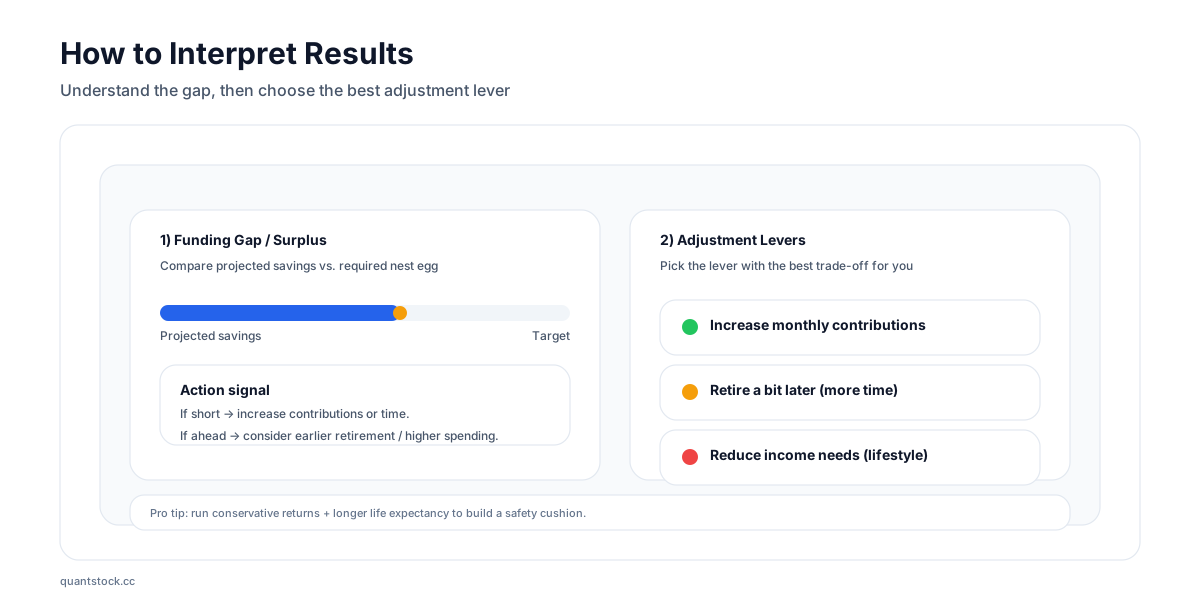
The calculator shows whether you're on track. If you're short, increase monthly contributions, adjust retirement age, or reconsider income needs. If you're ahead, consider early retirement or higher retirement spending.
How to Interpret the Results
Retirement Funding Gap (or Surplus): This is the difference between what you'll need and where you're currently headed. A negative gap means you're short and need to increase savings. A positive surplus means you're ahead of target.
Required Monthly Contribution: This is the exact monthly amount you should be saving to reach your goal. Compare this to your current contribution. If significantly higher, consider whether that's realistic or if you need to adjust other assumptions (later retirement, lower retirement income, etc.).
Savings Rate as Percentage of Income: Calculate this by dividing your required monthly contribution by your monthly gross income. Financial advisors typically recommend saving 15-20% of gross income for retirement. If your required rate exceeds 25%, you may need to adjust expectations or retirement timing.
Years to Retirement: More years until retirement means compound growth works more powerfully in your favor. Each additional year of saving and growth can reduce required monthly contributions significantly.
Real-World Use Cases
Case 1: Young Professional Starting Out
Alex, 25, earns $60,000 and contributes $300 monthly to a 401(k) with employer match. The calculator shows that continuing this pattern with 7% returns will provide approximately 60% income replacement at age 65. To reach the recommended 80%, Alex needs to increase monthly contributions to $500 as income grows.
Case 2: Mid-Career Catch-Up
Jamie, 45, has only $100,000 saved but earns $100,000 annually. The calculator reveals Jamie needs approximately $1.5 million for retirement at 65 with 80% income replacement. Current contributions aren't sufficient. By maximizing 401(k) contributions ($23,000 annually) and using catch-up contributions after age 50, Jamie can close the gap but must act now.
Case 3: Couple Planning Together
Both spouses, ages 40 and 42, have combined retirement savings of $250,000 and contribute $1,200 monthly combined. The calculator shows they're slightly behind their goal of maintaining $120,000 annual retirement income. By each increasing their 401(k) contributions by $200 monthly, they get back on track.
Case 4: Early Retirement Planning
Taylor, 30, wants to retire at 55. Even with aggressive saving ($2,000 monthly) and investment returns, the calculator shows the challenge of only 25 years of savings and 30+ years of retirement to fund. Taylor adjusts expectations to retirement at 58, making the plan more feasible.
Common Mistakes to Avoid
Underestimating Life Expectancy
Many people plan for retirement ending at 85-88, but life expectancies are increasing. If you're healthy, plan for living into your 90s. Running out of money at 87 after planning for 85 is a devastating mistake.
Forgetting Healthcare Costs
Medicare doesn't cover everything. Many retirees spend $200,000+ on healthcare in retirement. Factor additional healthcare costs into your retirement income needs, especially if retiring before 65 (when Medicare begins).
Ignoring Social Security
Social Security provides significant retirement income for most Americans. However, don't assume you'll receive 100% of estimated benefits—conservative planning uses 75-80% of projected Social Security to account for potential future program changes.
Using Too Aggressive Return Assumptions
Assuming 10-12% returns is dangerous. As you near retirement, your portfolio typically becomes more conservative (more bonds, less stocks), lowering expected returns. Use 6-8% for realistic long-term planning.
Not Accounting for Sequence of Returns Risk
The calculator assumes steady returns, but market timing matters enormously. A market crash in your first years of retirement can devastate your plan even if long-term returns average correctly. Build in cushion by targeting 10-15% more savings than the calculator suggests.
Forgetting Taxes
Money in traditional 401(k)s and IRAs is taxed when withdrawn. If you have $1 million in a traditional 401(k), you don't actually have $1 million in spending power—it's closer to $700,000-$800,000 after taxes. Roth accounts provide tax-free retirement income, which is advantageous for planning.

Related Calculators
Retirement planning connects to several other financial planning areas:
Compound Interest Calculator - See exactly how your retirement contributions will grow over time with compound returns. This helps you understand the power of starting early and contributing consistently.
Emergency Fund Calculator - Before maximizing retirement contributions, ensure you have adequate emergency savings. Calculate your ideal emergency fund size so unexpected expenses don't force you to raid retirement accounts.
Mortgage vs Investing Calculator - Should you pay off your mortgage early or maximize retirement contributions? This calculator helps you determine the optimal strategy for your situation.
Frequently Asked Questions
Q: Should I count Social Security in my retirement planning?
Yes, but conservatively. Social Security should cover 25-40% of retirement income for most people. Access your Social Security statement online to see estimated benefits. However, plan for benefits being 75-80% of current projections to account for potential future program changes.
Q: What if I'm behind on retirement savings?
Options include: increasing contribution rates, working a few years longer, reducing retirement spending expectations, taking on a part-time job in early retirement, or downsizing your home. The calculator helps you model these scenarios. Even small increases in contributions or working 2-3 extra years can dramatically improve outcomes.
Q: How much should I have saved by specific ages?
General guidelines suggest: 1x annual salary by 30, 3x by 40, 6x by 50, 8x by 60, and 10x by 67. These are rough benchmarks. Use the calculator for your specific situation since retirement goals vary widely.
Q: Should I prioritize 401(k) or IRA contributions?
Contribute to 401(k) up to the employer match first (free money). Then max out Roth IRA if eligible ($6,500 annually, $7,500 if over 50). Then return to 401(k) to contribute up to annual limits ($22,500, $30,000 if over 50). This order optimizes tax advantages and investment options.
Q: What's the 4% rule and is it still valid?
The 4% rule suggests withdrawing 4% of your retirement portfolio in year one, then adjusting for inflation annually. Research suggests 3.5% is safer for 30+ year retirements. The calculator uses sustainable withdrawal rates based on your specific time horizon.
Q: Can I retire early on less savings with reduced spending?
Yes, but carefully. Early retirement requires larger nest eggs because you have more years to fund and fewer years to save. The FIRE (Financial Independence Retire Early) movement proves it's possible with aggressive saving and controlled spending. Use the calculator to model specific early retirement scenarios.
Q: Should I include home equity in retirement planning?
Only if you plan to downsize or use a reverse mortgage. Your primary residence provides housing but not liquid retirement income unless you sell it. Conservative planning excludes home equity or only includes the amount you'd receive from downsizing (selling a $500k home and buying a $300k home provides $200k for retirement, minus transaction costs).
Q: What if my spouse is much older or younger?
Use the younger spouse's age for life expectancy in the calculator since retirement savings need to fund both lifespans. If there's a significant age gap, plan for the younger spouse potentially living many years after the older spouse passes away.
Take Control of Your Retirement Future
Retirement planning isn't optional—it's essential. Social Security alone won't provide comfortable retirement. Most Americans need substantial personal retirement savings to maintain their lifestyle.
The good news is that with proper planning and consistent execution, comfortable retirement is achievable for most people. The key is starting early, contributing consistently, taking full advantage of employer matches and tax benefits, and adjusting your plan as circumstances change.
Use this calculator annually to ensure you're on track. Make it part of your financial routine, like checking your credit score or reviewing your budget. Small adjustments now prevent major problems later.
Calculate your retirement needs today with our retirement planning calculator and start building the retirement you deserve. For comprehensive portfolio management, explore our portfolio optimization tools to maximize your retirement savings growth.
Free Trading Math & Risk Cheat Sheet
Every key formula in one PDF: breakeven win rates, expectancy, position sizing, drawdown recovery, volatility drag, VaR and CVaR. Plus occasional emails when we publish new quant tools.