Mortgage vs Investing Calculator: Should You Pay Off Your Mortgage Early?
The Mortgage Prepayment vs Investing Decision
One of the most common financial dilemmas homeowners face is deciding whether to make extra mortgage payments or invest that money instead. Both strategies build wealth, but which builds more? Our mortgage vs investing calculator provides the mathematical answer based on your specific situation, helping you make the optimal decision.
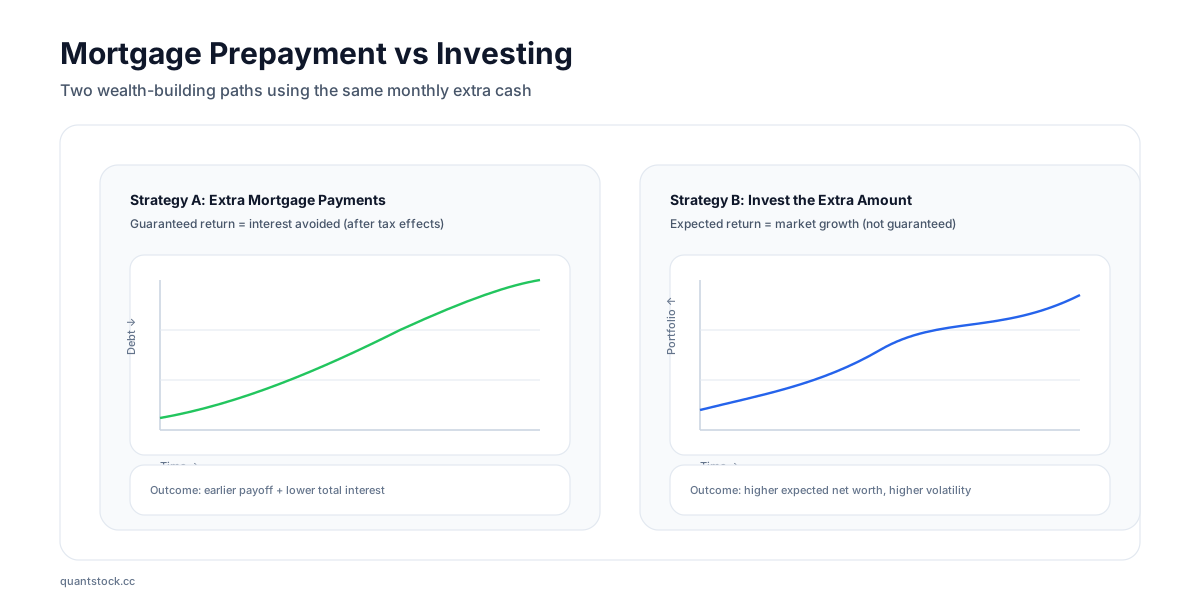
What This Calculator Does
The mortgage vs investing calculator compares two strategies side-by-side using your actual numbers:
Strategy 1: Extra Mortgage Payments - The calculator shows how extra principal payments reduce your mortgage balance, how much interest you'll save, and when you'll pay off your mortgage. You'll see the guaranteed return from avoided interest and the psychological benefit of becoming debt-free sooner.
Strategy 2: Investing the Same Amount - The calculator projects what your investment portfolio would be worth if you invested the extra payment amount instead of prepaying your mortgage. This assumes your standard mortgage payments continue on schedule while your investment account grows separately.
Head-to-Head Comparison - The calculator quantifies the difference in net worth between both strategies, showing which leaves you financially better off after the same time period. It accounts for tax implications, including mortgage interest deductions and investment taxes.
Break-Even Analysis - The calculator determines the investment return rate at which both strategies produce equal outcomes, helping you understand how certain you need to be about investment returns to justify investing over prepayment.
Who Should Use This Calculator
This calculator is valuable for:
Homeowners with disposable income who have extra money each month beyond required mortgage and essential expenses. You've already maxed retirement contributions and built your emergency fund—now you're deciding how to deploy additional savings.
Those with low mortgage interest rates wondering if the current low rate justifies keeping the mortgage and investing instead. When mortgage rates are below 4%, the math often favors investing.
People approaching retirement who want to enter retirement debt-free but also need to ensure their investment portfolio is adequate. The calculator helps balance these competing goals.
High-income earners who receive bonuses, inheritances, or other windfalls and need to decide between mortgage prepayment and investment.
How the Calculator Works
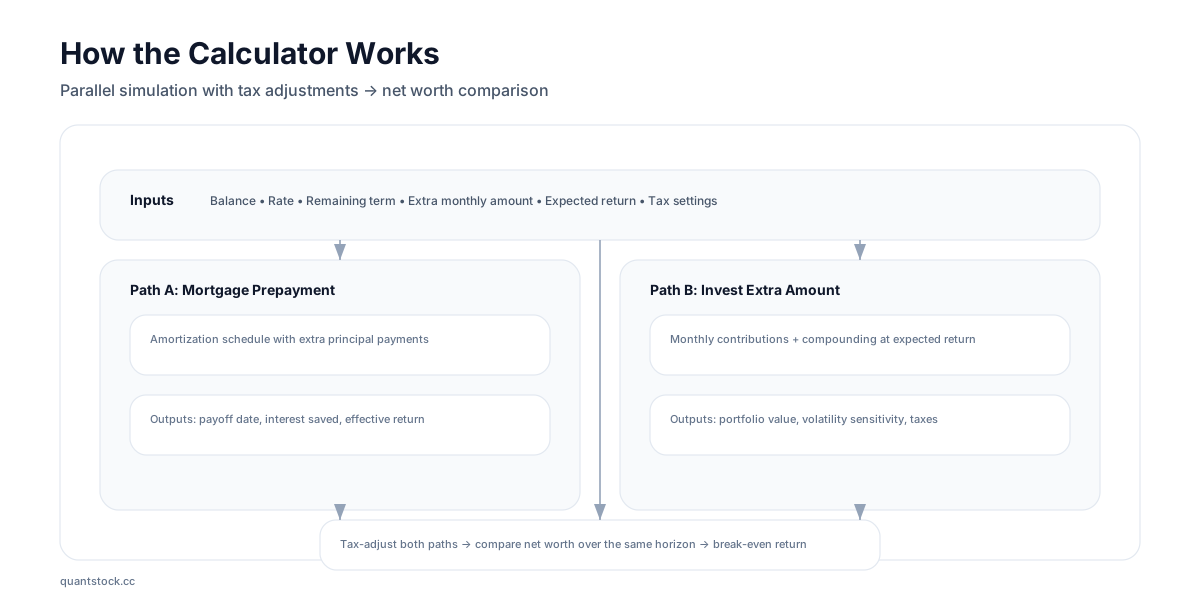
The mortgage vs investing calculator runs parallel analyses:
Mortgage Prepayment Calculation
Starting with your current mortgage details (balance, interest rate, remaining years), the calculator:
- Calculates your standard mortgage payment
- Adds your extra payment to principal each month
- Recalculates the reduced balance and interest for each subsequent month
- Tracks total interest saved
- Determines the new payoff date
- Calculates your "effective return" (interest saved divided by extra payments made)
Investment Growth Calculation
Using the same extra payment amount, the calculator:
- Invests this amount monthly into an investment account
- Applies your expected annual return rate monthly
- Compounds returns over the same time period
- Subtracts estimated capital gains taxes on growth
- Shows final portfolio value
Tax-Adjusted Comparison
The calculator accounts for:
- Mortgage interest deduction (if you itemize taxes)
- Effective tax rate on mortgage interest savings
- Capital gains taxes on investment returns
- Different tax treatment for taxable vs. tax-advantaged accounts
Net Worth Difference
The calculator shows your net worth advantage from each strategy:
- With mortgage prepayment: Mortgage paid off earlier + remaining debt versus equivalent time period
- With investing: Larger investment portfolio but mortgage remains longer
- Net difference: Which strategy leaves you better off financially
How to Use the Calculator (Step-by-Step)
Step 1: Enter Your Current Mortgage Balance
Input the remaining principal on your mortgage. Check your latest statement or loan servicer website for the exact amount.
Step 2: Input Your Mortgage Interest Rate
Enter the annual percentage rate (APR) on your mortgage. For variable-rate mortgages, use your current rate and note that results may change if rates adjust.
Step 3: Enter Remaining Mortgage Term
Input how many years remain on your mortgage. A 30-year mortgage taken out 5 years ago has 25 years remaining.
Step 4: Set Your Extra Monthly Payment Amount
Enter the additional amount you could pay toward your mortgage or invest. Be realistic—this should be sustainable long-term, not an amount that strains your budget.
Step 5: Input Expected Investment Return
Enter the annual return you expect from investments. Conservative estimates use 6-7%, moderate estimates use 7-8%, aggressive estimates use 8-10%. Remember that returns aren't guaranteed and this significantly affects results.
Step 6: Enter Your Tax Rate
Input your marginal federal income tax rate. This affects the value of mortgage interest deductions and investment tax implications. Use your actual tax bracket: 22%, 24%, 32%, etc.
Step 7: Indicate Whether You Itemize Deductions
If you itemize deductions and deduct mortgage interest, select "yes." If you take the standard deduction (most people after 2018 tax reform), mortgage interest doesn't provide tax benefits, making prepayment more attractive.
Step 8: Choose Account Type
Select whether investments would be in taxable accounts (brokerage) or tax-advantaged accounts (401k, IRA). Tax-advantaged accounts make investing more attractive since they defer taxes on gains.
Step 9: Review Results
Compare the final wealth under each strategy. The calculator shows which approach leaves you better off and by how much. Review the payoff timeline, interest saved, investment growth, and net advantage.
How to Interpret the Results
Years Until Mortgage Payoff: With extra payments, you'll pay off your mortgage significantly faster. A 30-year mortgage with aggressive extra payments might be paid off in 15-20 years. The psychological freedom of being debt-free is valuable but not captured in mathematical calculations.
Total Interest Saved: This is the guaranteed benefit of extra payments. If your mortgage would cost $200,000 in interest over its full term but extra payments reduce that to $120,000, you've saved $80,000. This is a risk-free return.
Investment Portfolio Value: This is what your investment account would be worth if you invested the extra payment instead. This is not guaranteed—it depends on actual market returns matching your assumptions.
Net Worth Advantage: This is the difference between strategies. Positive numbers favor investing; negative numbers favor mortgage prepayment. Consider:
- Small differences (under 10%) suggest either strategy works fine
- Moderate differences (10-30%) suggest one strategy is clearly better mathematically
- Large differences (over 30%) suggest one strategy is substantially superior
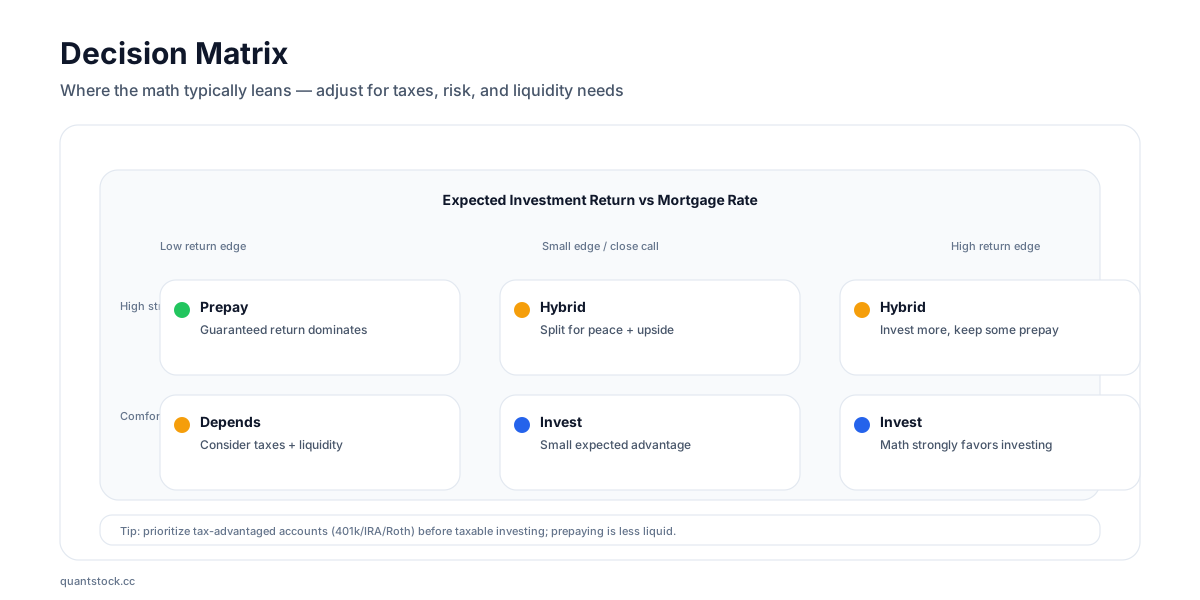
Effective Return Rate: Your mortgage interest rate represents the guaranteed return from prepayment. Compare this to expected investment returns:
- If mortgage rate is 6.5% and expected investment return is 7.5%, the difference is small—personal preference matters
- If mortgage rate is 3.5% and expected investment return is 8%, math strongly favors investing
- If mortgage rate is 7% and expected investment return is 6%, prepayment is safer

Real-World Use Cases
Case 1: Low Rate Mortgage
Sarah has a $300,000 mortgage at 3.2% interest with 25 years remaining. She can deploy $500 monthly toward either mortgage or investments. The calculator shows investing produces approximately $40,000 more net worth over 25 years assuming 7% investment returns. Sarah invests the money since her guaranteed return from prepayment (3.2%) is much lower than likely investment returns.
Case 2: High Rate Mortgage
Michael has a $200,000 mortgage at 6.8% interest with 20 years remaining. He has $800 monthly to deploy. The calculator shows mortgage prepayment saves approximately $55,000 in interest and pays off the mortgage in 12 years. Investment strategy requires 8%+ returns to match this, which isn't guaranteed. Michael chooses mortgage prepayment for the guaranteed return.
Case 3: Retirement Timeline Considerations
Jennifer, 50, has $150,000 mortgage at 4.5% with 15 years remaining. She plans to retire at 65. The calculator shows that $1,000 monthly extra payments would pay off her mortgage by age 62, three years before retirement. This guarantees debt-free retirement. Jennifer chooses mortgage prepayment for the peace of mind despite investment strategy potentially yielding higher returns.
Case 4: Tax-Advantaged Account Opportunity
David has a $400,000 mortgage at 4.2% but can contribute extra money to his 401(k) (investment strategy) or make extra mortgage payments. The calculator shows 401(k) contributions provide immediate tax deduction (22% bracket) plus tax-deferred growth, making the effective advantage much larger than mortgage prepayment. David maximizes 401(k) contributions.
Common Mistakes to Avoid
Using Unrealistic Investment Return Assumptions
Assuming 10-12% investment returns makes investing look amazing, but most investors don't achieve these returns over long periods after accounting for fees, taxes, and behavioral mistakes. Use conservative return assumptions (6-8%) for reliable comparisons.
Forgetting About Risk
Mortgage prepayment is a guaranteed return (saved interest). Investing is not guaranteed. During market crashes, investment portfolios decline 30-50%. If you can't handle this volatility, the higher expected return from investing may not be worth the stress.
Ignoring Liquidity Needs
Money paid toward your mortgage is locked in your house—you can't easily access it without selling or getting a home equity line of credit. Investments remain liquid. If you might need the money for other purposes (business opportunity, child's education, emergency), investing maintains flexibility.
Not Considering Time Horizon
If you're planning to sell your house in 3-5 years, extra mortgage payments provide little benefit since you're not keeping the house long term. Investments are better for short ownership periods.
Forgetting Behavioral Psychology
Math might favor investing, but if having a mortgage creates significant stress or if you know you'd spend investment account money impulsively, mortgage prepayment's psychological benefits and forced savings matter more than theoretical extra returns.

Related Calculators
This decision connects to your broader financial picture:
Compound Interest Calculator - If you choose the investment strategy, use this calculator to see exactly how your monthly investments will grow over time with compound returns.
Retirement Planning Calculator - Ensure your retirement savings are on track before deploying extra money toward mortgage prepayment. Retirement savings should generally take priority.
Emergency Fund Calculator - Before making extra mortgage payments or investing aggressively, ensure you have an adequate emergency fund. Without this foundation, you might be forced to go into debt when emergencies arise.
Frequently Asked Questions
Q: What if I'm not sure about my investment return assumption?
Run the calculator multiple times with different return scenarios: conservative (6%), moderate (7.5%), and aggressive (9%). See how the decision changes. If mortgage prepayment wins even in moderate scenarios, it's safer. If investing only wins with aggressive assumptions, prepayment might be wiser.
Q: Should I refinance my high-rate mortgage or invest?
If current rates are 2%+ lower than your rate, refinancing should be your first priority. After refinancing to a lower rate, use this calculator to compare the new mortgage prepayment versus investing.
Q: Can I split the extra money between both strategies?
Absolutely. Many people use a hybrid approach: 50% to mortgage prepayment for psychological peace, 50% to investments for growth. This balances security and upside. Use the calculator to model the hybrid approach.
Q: Does this calculator account for home value appreciation?
No—home value appreciation happens regardless of whether you prepay your mortgage or not. Prepaying your mortgage doesn't make your home worth more (though it increases your equity faster). Both strategies assume your home appreciates equally.
Q: Should I prepay mortgage or max out my Roth IRA?
Max the Roth IRA first (up to annual limits: $6,500 or $7,500 if over 50). Tax-free growth in Roth IRAs is incredibly valuable. After maxing Roth contributions, use this calculator to decide between mortgage prepayment and additional taxable investing.
Q: What if interest rates rise and I can invest my money at higher rates later?
You can't predict future interest rates. Make decisions based on current opportunities. If you wait for perfect conditions, you might never act. The extra payment or investment you make today grows regardless of future rate changes.
Q: Does having a mortgage help my credit score?
Having a mortgage in good standing does help your credit score by showing responsible debt management. However, this is a minor consideration compared to the financial math of mortgage vs investing. Make the decision based on wealth maximization, not credit score.
Q: Should I prioritize mortgage prepayment if I expect inheritance or windfall?
Future windfalls are uncertain. Make financial decisions based on your current situation. If you receive a windfall later, you can reassess then. Don't count on money you don't have yet.
Make Your Decision with Confidence
The mortgage vs investing decision is personal and mathematical. Run the numbers with your specific situation, but also consider psychological factors like stress tolerance, liquidity needs, and life plans.
Neither strategy is "wrong"—both build wealth. The difference is usually moderate, meaning your personal preferences matter significantly. Many successful people chose mortgage prepayment; many equally successful people chose investing. The important part is making an informed decision and executing consistently.
Calculate your optimal strategy today with our mortgage vs investing calculator and build wealth with confidence. For comprehensive portfolio management, explore our portfolio optimization tools to maximize investment returns.
Free Trading Math & Risk Cheat Sheet
Every key formula in one PDF: breakeven win rates, expectancy, position sizing, drawdown recovery, volatility drag, VaR and CVaR. Plus occasional emails when we publish new quant tools.